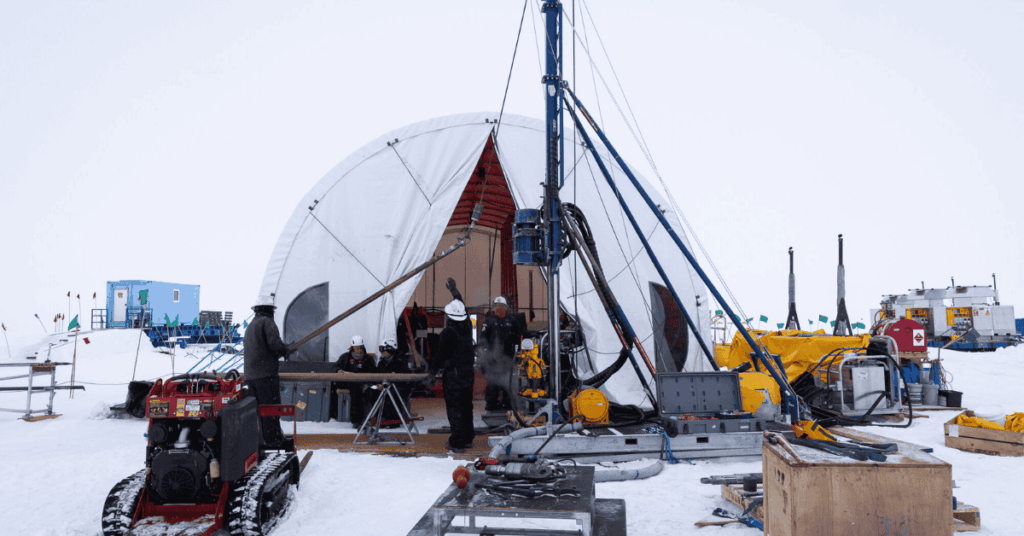
A major scientific milestone has been achieved in one of the most isolated places on the planet. A multinational team of scientists has drilled deep beneath West Antarctica and recovered a 228-meter-long rock and sediment core—the deepest sample ever collected from below the Antarctic ice sheet.
This work is part of the SWAIS2C project, led by Earth Sciences New Zealand, Te Herenga Waka Victoria University of Wellington, and Antarctica New Zealand. Although it may appear to be only a long column of mud and rock, this core contains vital evidence about Earth’s climate history and may help scientists better understand the future of sea level rise.
How and Where the Core Was Recovered
The drilling operation took place at Crary Ice Rise, a remote site buried under 523 meters of solid ice and located over 700 kilometers from Scott Base. Working in such a harsh and isolated environment required advanced equipment, precision, and extensive planning.

Researchers first used a hot-water drill to create a vertical passage through the thick ice. After reaching the bottom, they lowered a specialized drill capable of cutting and lifting sediment sections up to 3 meters long. These pieces were brought to the surface one by one and joined together to form a complete 228-meter sediment core.
What makes this sample extraordinary is not only its length, but also the scientific story it may hold. Early findings indicate that the core preserves a record of environmental change stretching back around 23 million years.
Why This Discovery Is So Important
Sediment cores are often considered natural archives of Earth’s history. Each layer represents a different time period, with the youngest material near the top and the oldest buried deeper below. By examining these layers, scientists can trace changes in climate, oceans, and the behavior of ice sheets over millions of years.
This new core is especially valuable because it was taken from beneath the West Antarctic Ice Sheet—one of the most sensitive regions affecting global sea levels. If this entire ice sheet were to collapse, sea levels worldwide could rise by approximately 4 to 5 meters, or 13 to 16 feet.
Nearby, the Ross Ice Shelf plays a crucial protective role by acting like a barrier that slows glaciers from flowing rapidly into the ocean. Understanding how this region responded to warming in the past can help scientists estimate how it may react to climate change in the future.
Signs of a Much Warmer Antarctica
One of the most striking early observations is that parts of West Antarctica were not always hidden beneath massive ice. At certain times in the distant past, the region appears to have been covered by open ocean rather than thick glaciers.
The sediment layers provide strong clues:
Large stones, gravel, and coarse debris point to periods when glaciers dominated the landscape. In contrast, fine mud, shell fragments, and tiny marine organisms suggest times when the area was submerged under open water.
Some of these microscopic marine organisms need sunlight to survive, which indicates that the region must have been free of ice at specific points in its history. This finding challenges the old belief that this part of Antarctica remained permanently frozen at all times.
What Researchers Hope to Discover Next
The main purpose of studying this core is to understand how the Antarctic ice sheet reacts when the planet warms. Satellite data already shows that the ice sheet is losing mass, but scientists still do not know exactly how fast large-scale retreat could happen if warming continues.
By comparing present-day changes with evidence from past warm periods, researchers hope to identify patterns, thresholds, and possible tipping points. These insights can improve climate models and make future sea level projections more reliable.

Researcher Huw Horgan said the core may offer “critical insights” into how Antarctica behaves in a warmer climate. That knowledge is essential for assessing long-term global climate risks.
Global Impact of a Remote Discovery
Even though this breakthrough happened in a distant part of Antarctica, its consequences matter around the world. Rising sea levels threaten millions of people, particularly those living in coastal cities and vulnerable low-lying regions.
More accurate predictions can help countries and communities:
Strengthen infrastructure and flood protection, safeguard coastal habitats, and prepare for displacement caused by climate-related changes.
In that sense, this deep sediment core could become an important tool in helping humanity respond more effectively to climate change.
Closing a Major Scientific Gap
For many years, scientists have stressed the need for direct geological evidence from beneath the interior of the West Antarctic Ice Sheet. Most earlier records came from coastal or offshore areas, leaving large gaps in the understanding of inland ice history.
A 2022 study had already pointed out the importance of obtaining deeper and more inland records to fully reconstruct Antarctica’s past. This newly recovered core helps address that need by offering a clearer and more complete picture of how the ice sheet evolved over millions of years.
The Real Research Starts Now
Recovering the core was a remarkable engineering achievement, but the scientific investigation is only beginning. Experts from 10 countries are now examining the sample in detail.
They will work to determine the age of each layer, identify chemical and biological signals, and rebuild past records of ocean conditions and temperature. This process will take years, but the knowledge gained could significantly reshape our understanding of Earth’s climate system.
Conclusion
The recovery of a 228-meter sediment core from beneath West Antarctica marks a historic achievement in climate science. It opens an extraordinary window into Earth’s past, showing that even the coldest regions of the planet have undergone dramatic environmental shifts.
More importantly, it may help scientists better predict the future. As global temperatures continue to rise, understanding how Antarctic ice responded in earlier warm periods could be key to forecasting what lies ahead.
What seems like a simple column of mud and rock is actually a powerful archive of Earth’s history—and an important signal for the world’s future.