A Landmark Achievement in West Antarctica Reveals a 23-Million-Year Timeline of Earth’s Climate
The Extraction Breakthrough
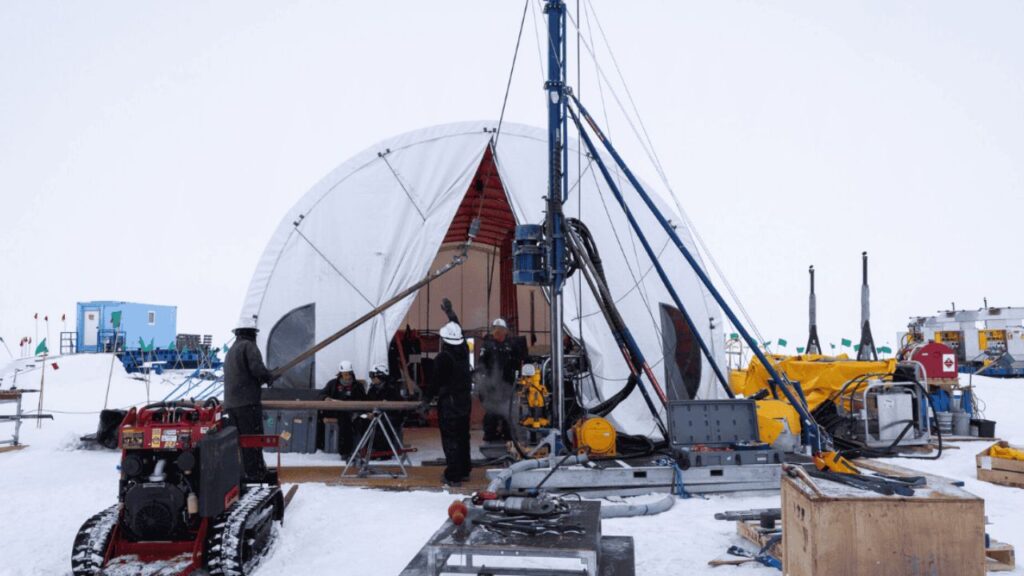
In one of the most remote areas on Earth, an international research team has achieved a historic milestone. As part of the SWAIS2C project, scientists successfully drilled through 523 meters of ice at Crary Ice Rise, extracting a 228-meter-long core of rock and sediment. This is the deepest sample ever obtained from beneath the Antarctic ice sheet, located over 700 kilometers from Scott Base.

The process involved using a hot water drill to penetrate the ice, followed by a specialized sediment drilling system to recover segments of Earth’s history in 3-meter increments.
Why This Discovery Matters
Sediment cores are like “timelines of Earth,” where each layer represents a distinct period in history. This core is significant because it comes from the West Antarctic Ice Sheet, a region that holds enough ice to raise global sea levels by 4 to 5 meters if it were to melt. Understanding the past stability of the Ross Ice Shelf, which serves as a barrier for inland glaciers, is crucial for predicting future climate trends.
Evidence of a Warmer Antarctica
The core offers compelling evidence that West Antarctica was not always covered by ice. Preliminary analysis reveals alternating layers that tell the story of dramatic shifts in climate:

- Coarse gravel: Indicates periods when massive glaciers blanketed the region.
- Fine mud and shell fragments: Suggests eras of open ocean and warmer temperatures.
- Photosynthetic organisms: The presence of microscopic marine life requiring sunlight proves that the region was once ice-free.
Global Implications
The data extracted from this 23-million-year-old core will help refine global climate models. By identifying the tipping points of past ice sheet retreats, governments can better prepare for long-term risks, including:
- Strategic planning for coastal infrastructure and flood defenses.
- Protection of vulnerable coastal ecosystems.
- Better preparation for climate-driven human migration.
The Future of the Research
Recovering the core is just the first step. Experts from 10 nations are now beginning a multi-year analysis to determine the exact ages of the layers and reconstruct ancient ocean conditions. This project fills a critical gap in scientific knowledge, moving beyond coastal data to provide a direct record of Antarctica’s interior history.
A landmark achievement by SWAIS2C, Earth Sciences New Zealand, and international partners.